
Small Business Marketing Stack: Audit Framework & Fix
August 6, 2026
Why Your Marketing Stack Keeps Growing (and Costing More)
No small business sets out to run twelve marketing tools. It happens one decision at a time: a landing page builder for a launch, an email platform once the newsletter outgrows Gmail, a scheduling tool, a separate analytics dashboard. Each choice made sense alone. Nobody designed a system — it assembled itself quietly over two or three years.
This is marketing tool sprawl, and it's not niche. SaaS spend for small businesses has climbed as more functions get unbundled into standalone apps — a trend visible enough that companies are now working to reverse it. According to the BetterCloud 2025 State of SaaSOps Report, average SaaS application counts per organization have started declining for the first time in years — not because businesses need less software, but because they're finally auditing what they pay for and cutting overlap. Marketing functions sprawl fastest, since so many point solutions exist for narrow jobs like SEO tracking, ad management, or SMS campaigns. The Zylo 2026 SaaS Management Index confirms this specifically in martech, showing marketing SaaS app counts continuing to grow even as overall software budgets tighten — with few marketers reporting their stack feels integrated.
If your bill has crept up without a corresponding jump in results, you're not managing a marketing stack — you're managing sprawl.
The Real Cost of a Fragmented Stack
The subscription total is the visible cost. The bigger cost is what happens between the tools.
Overlapping features paid for twice. Most all-in-one email platforms include basic landing pages. Most CRMs include some form of email sending. Most social schedulers include rudimentary analytics. Buy a dedicated tool for each function anyway, and you're often paying twice for the same capability — once as a minor feature in Tool A, again as the primary product of Tool B.
The integration tax. When your ad platform doesn't talk to your CRM, and your CRM doesn't talk to your email tool, someone becomes the human API — exporting CSVs, manually tagging leads, cross-checking dashboards before a Monday meeting. This time never shows up as a line item, but it drains hours weekly. Benchmarks on SaaS tools for small businesses put per-employee software spend and typical tool counts high enough that consolidation audits regularly uncover meaningful, immediate savings once businesses map out what they're actually using — see Tecveq's roundup of SaaS tools for small business owners.
The login-and-renewal tax. Every additional tool means another password, another admin seat, another renewal date, another vendor to onboard new hires into. Unused or duplicate licenses are among the most consistently cited waste categories in SaaS management research — seats nobody logs into, plans nobody downgraded after a team member left.
None of this shows up neatly on an invoice. It shows up as a slower team and a fuzzier picture of what's actually working.
The Core Functions Every Small Business Marketing Stack Needs
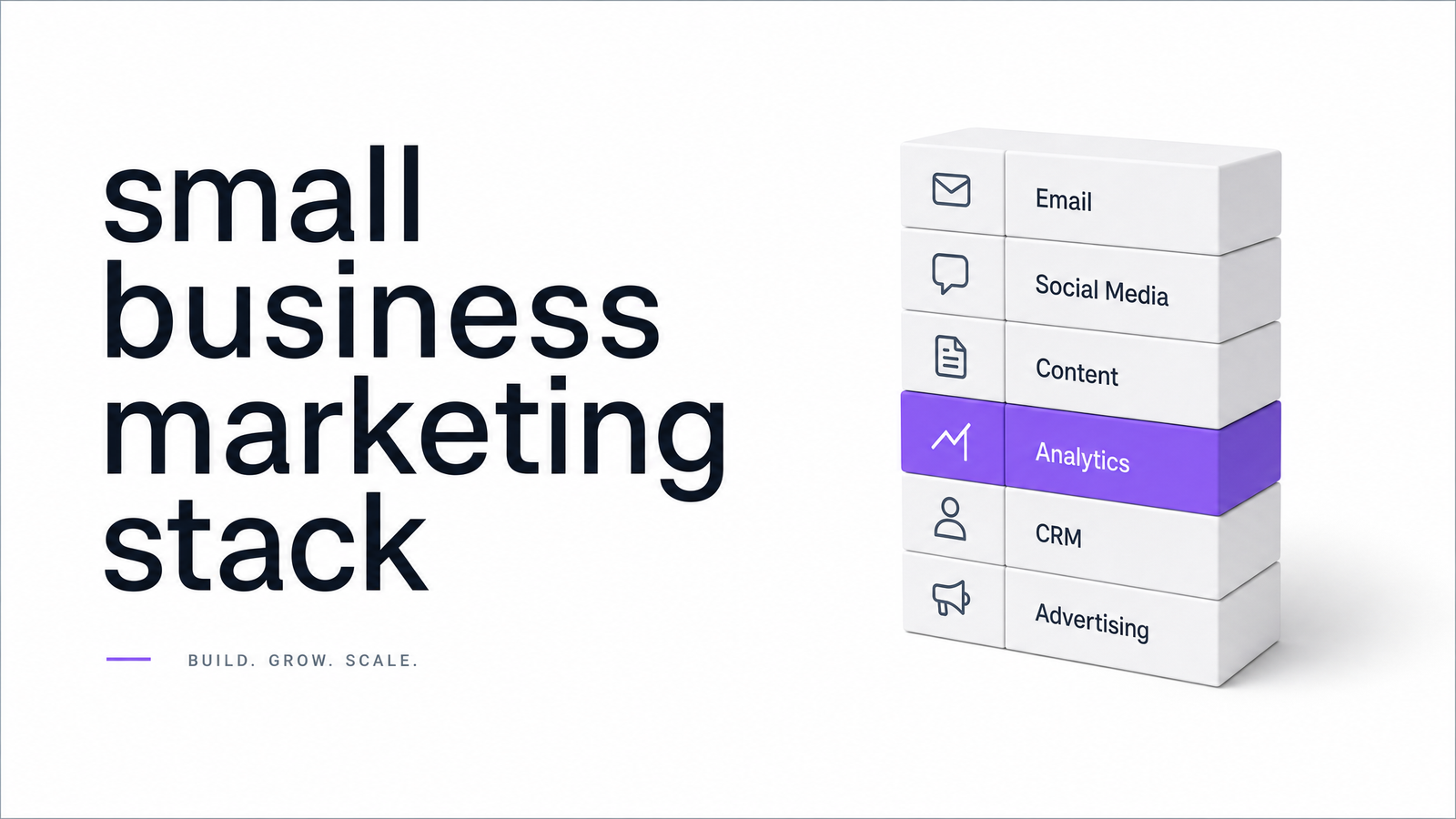
Most SMBs don't need dozens of tools — they need a handful of functions covered well. Before evaluating any vendor, define the job list:
- Website and landing pages — the foundation everything else drives traffic to. See our framework for website UX optimization for what actually moves conversion.
- SEO — organic visibility that compounds over time instead of resetting every billing cycle.
- Paid advertising — for demand you need now, not just later. Our guide to AI advertising for SMBs covers what this function should look like in 2026.
- Email and SMS marketing — direct-owned channels you don't rent from an algorithm.
- Social scheduling — consistent presence without daily manual posting.
- CRM and lead tracking — one source of truth for who's in your pipeline and where.
- Analytics and reporting — a single view of what's working, not seven disconnected ones.
SEO and paid search should also work in tandem rather than as separate silos — our practical framework for SEO and PPC integration explains why. Evra's product suite maps directly to this checklist, function by function, which is a more useful comparison than shopping category by category.
How to Audit Your Current Stack
A marketing stack audit doesn't require a consultant — it requires an hour and a spreadsheet.
Step 1: List every tool and its monthly cost. Pull your last three credit card statements. Everything billed monthly or annually that touches marketing goes on the list, including "free" tools with paid upgrades you forgot you enabled.
Step 2: Map each tool to a core function. Using the checklist above, assign every tool to the function it serves. If a tool doesn't map cleanly to any function, that's your first red flag.
Step 3: Flag overlaps and underused tools. Where two or more tools cover the same function, you're paying twice. Where a tool has one active user or hasn't been logged into in 60 days, it's a candidate to cut regardless of overlap. This is usually where owners realize how many marketing tools they actually need versus how many they're paying for — and the gap is almost always wider than expected.
When Consolidating Into One Platform Makes Sense
Point solutions make sense when you need genuine depth in one function and are prepared to manage the integration work yourself. Consolidation starts winning once you cross a rough tipping point: five or more overlapping tools, or a team regularly losing hours to manual data transfer between platforms. At that stage, the cost of a fragmented stack — subscriptions plus integration tax plus admin overhead — usually exceeds the cost of one all-in-one marketing software subscription covering the same functions.
Be honest about the tradeoffs. Consolidating means migration effort — exporting contacts, rebuilding automations, retraining your team on new interfaces. It can also mean occasional feature depth gaps if you relied heavily on an advanced capability inside a specialist tool. The right question isn't "does the all-in-one platform do everything my old tools did," it's "does it cover my core functions well enough that the savings and simplicity outweigh what I give up." For most SMBs running six to ten overlapping subscriptions, the math favors consolidation. Check Evra's pricing against your current per-tool total before deciding either way.
Frequently Asked Questions
How many marketing tools does a typical small business actually need?
Most small businesses can cover their marketing needs with tools mapped to seven core functions: website/landing pages, SEO, paid advertising, email/SMS, social scheduling, CRM, and analytics. That often means far fewer standalone subscriptions than the eight-plus tools many SMBs end up accumulating over time.
What's the difference between a marketing stack and a marketing tech platform?
A marketing stack is the full set of tools a business uses to cover its marketing functions, regardless of how many separate vendors that involves. A marketing tech platform consolidates multiple of those functions into a single product and subscription, reducing the number of vendors while covering the same underlying needs.
How do I know if my business has too many marketing tools?
Run the three-step audit: list every tool and its cost, map each to a core function, then flag overlaps and low-usage tools. If two or more tools cover the same function, or several have barely been logged into in the last two months, you likely have more tools than you need.
Is it cheaper to use one all-in-one marketing platform or separate best-in-class tools?
For businesses paying for five or more overlapping point solutions, one consolidated subscription is usually cheaper once you account for duplicate features, integration overhead, and unused licenses. Best-in-class point tools can still win on raw feature depth in a single function, but that depth often costs more than most SMBs actually use.
What core functions should every small business marketing stack cover?
Every SMB stack should cover website/landing pages, SEO, paid advertising, email/SMS marketing, social scheduling, CRM/lead tracking, and analytics/reporting — the non-negotiable jobs a marketing stack needs to do, regardless of which vendors fill them.
How much should a small business expect to spend on marketing software each month?
Spend varies widely, but SMB benchmarks show meaningful per-employee SaaS costs once tools are added function by function rather than planned as a system. Auditing and consolidating overlapping subscriptions is where most businesses find the fastest, most reliable savings without cutting functionality.
Map your own tools against the seven core functions above, and see where the overlaps and gaps actually are — that alone usually pays for the audit. Then look at Evra's products to see how one subscription covers that same checklist, and compare Evra's pricing against what you're currently paying across separate tools. If the math works, Evra is built to be the one bill that replaces the rest.
Originally published on Rankevra.